






by Fred Moleck
Upbeat
A younger parish musician in Rochester, New York, is showing uncanny skills in strategic planning in his ministry. His parish is investigating the selection of a new hymnal-service book for use at their liturgies.
He has formed a committee-a good start in enablement. That's real smart because the decisions will not be unilateral.
He has made assignments to each member of the committee to compile information on hymnals from three different publishers who service the Roman Catholic market. That's equally smart because committee members should have tasks with deadlines.
He has conferred with several gurus in the church music business to get their histories with the hymnals that will be under consideration. That's real smart because it is the evaluation from the dude or dudette from out of town that frequently carries the argument for the choice of the hymnal.
In other words, the project is more than enforcing one's personal choice. He is taking seriously the frequently neglected post-conciliar virtue: collegiality. What is hopeful is that he had not been born yet when the Constitution on the Sacred Liturgy was promulgated!
When the needs were being assessed, part of the vox populi/vox dei contingency asserted their need for "upbeat" music." It was a new term for the youthful parish musician whiz. For him, upbeat means the pickup note, or the fourth beat to the first measure of 4/4.
He soon realized that upbeat for these folks had nothing to do with counting time, but it was an indicator to a style of music and performance practice.
They wanted music that was lively, never in a minor key (unless it was "Our God Is an Awesome God"), always performed quickly, and instantly gratifying.
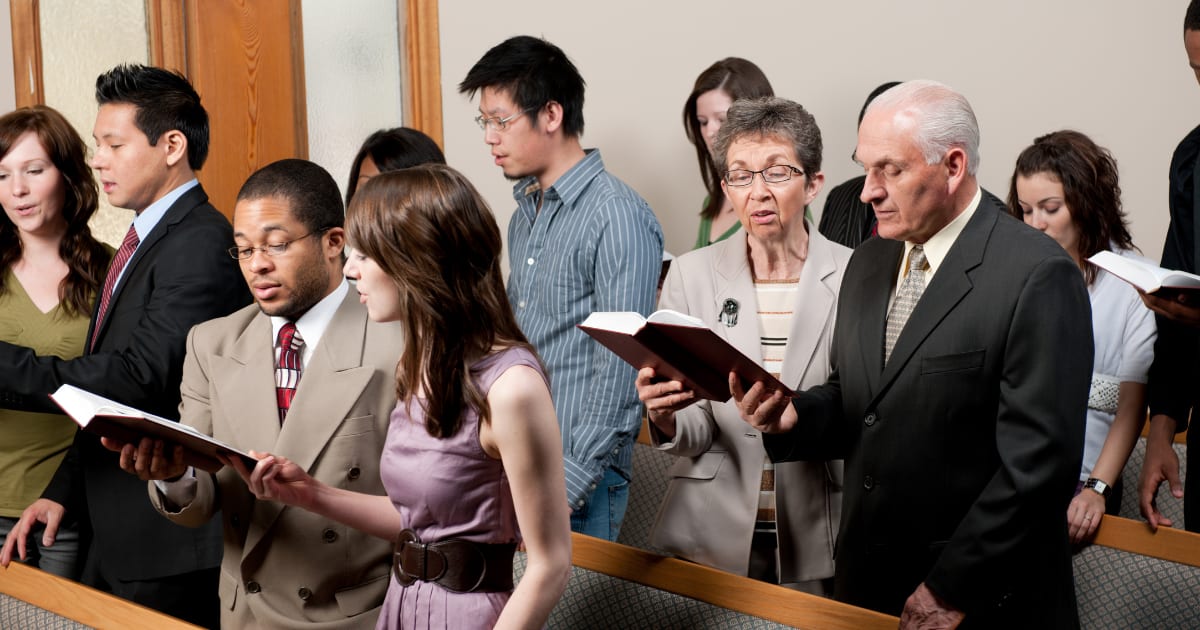
The style is not unknown to both Catholic and Protestant music circles. Protestant musicians encounter it in the praise choruses, which are widely used across the United States. Simple harmonic progressions, heavy rhythms, and profuse repetition are characteristics.
Catholics experience upbeat music in the contemporary folk-style idiom, which is nearly 100 percent verse-and-refrain, simple harmonic progressions, and texts that, any more, are rarely Scripture or Scripture paraphrases.
Both Catholic and Protestant ensembles have gone way beyond the acoustic guitar and bass. There usually is a bank of electronic equipment devices and speakers and more microphones than there are musicians.
"Upbeat" music is more of a cultic expression of worship than it is of a musical style. Usually the cult sees itself as a less formal with a loosely ritualistic ecclesiology.
Twenty years ago, the style of worship would have been called "low church." Today we call it . . . well, I don't think we call it anything, but its music has been called "upbeat."
What needs to be addressed in the analysis and judgment of the "upbeat" trend is a sharp look at performance practices in all of the music of a church's repertory.
Does the music leadership excite lively worship with strong tempos and articulated phrasing?
Does the musician understand the importance of improvisation and rhythmical organization? Andra� Crouch's "Soon and Very Soon" is distorted so many times by a music minister who takes it at a breakneck tempo.
Next week, let's dig more deeply into some performance practices that would help fill the need for "upbeat" music without suspending musical judgment and style.
READER ALERT: For six weeks, my computer and my e-mail have been down. After prayer, good works, and another $1,000.00, I am now communicable. If any of you e-mailed me and didn't receive my usual immediate response, it was not because of malice, but because of cyberspatial breakdown. Please try again: fmoleck@earthlink.net
You can reach Fred Moleck via email at fmoleck@earthlink.net